Step 1
Target Recognition
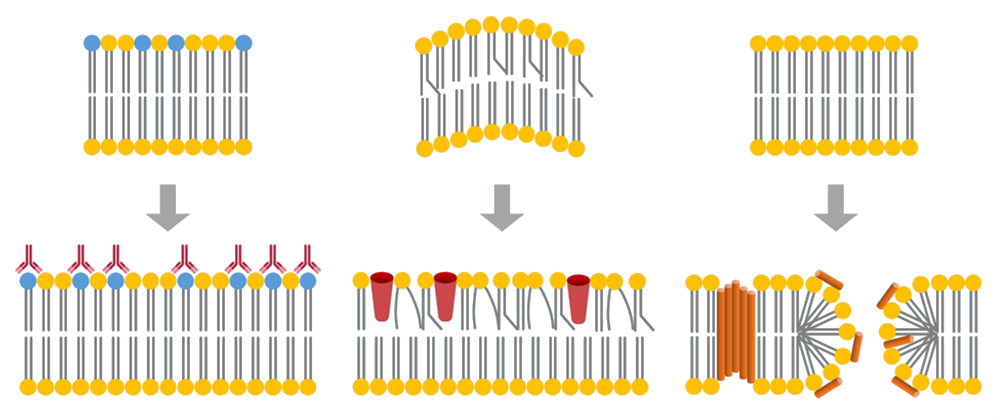
AH-D recognizes highly curved lipid membranes characteristic of viral envelopes and extracellular vesicles.

AH-D is positioned as a membrane-active peptide approach for enveloped viruses, based on curvature-dependent pore formation in tightly curved nanoscale lipid membranes.
Pandemic preparedness planning must account for known, unknown, and understudied viruses. Broad-spectrum antiviral strategies can provide first-line countermeasure rationale when mechanism and evidence support the use case.
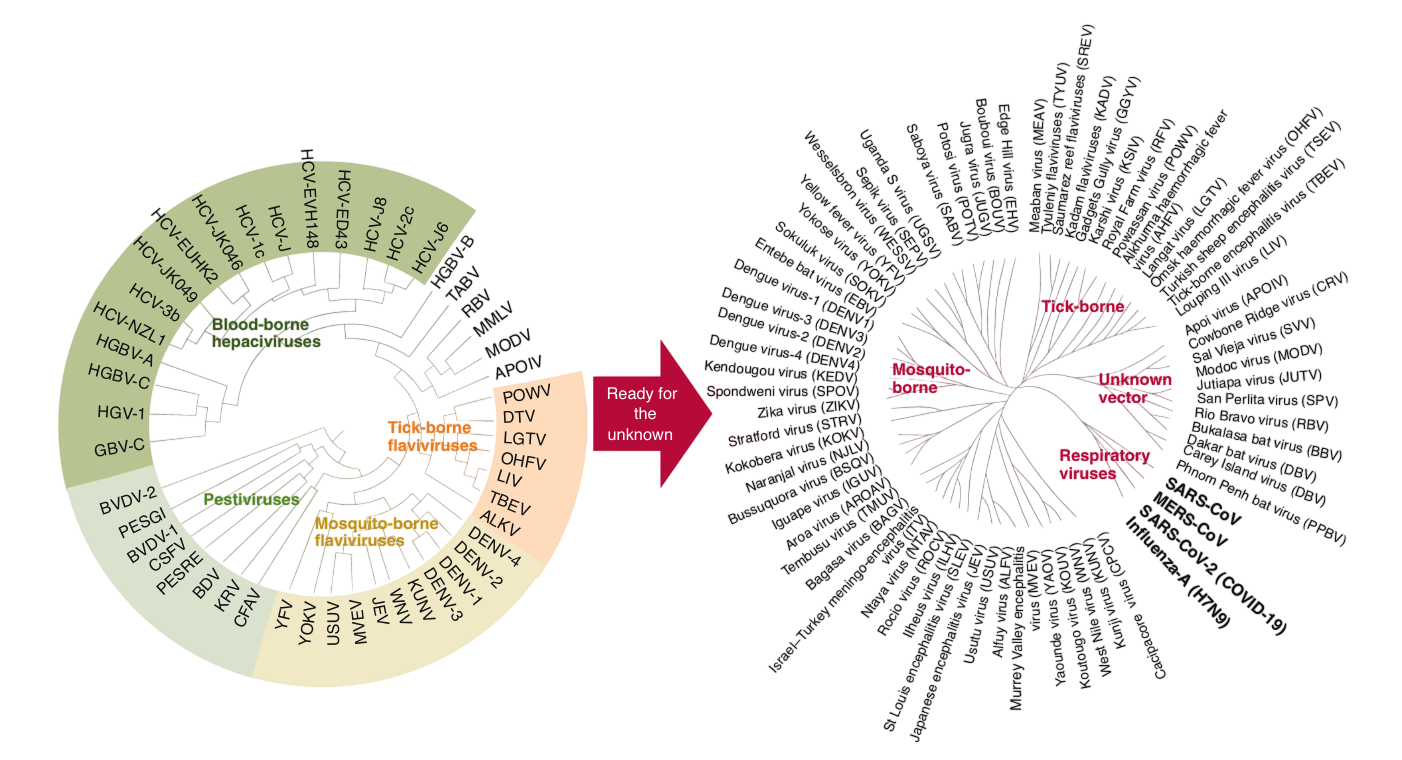
AH-D is Macro HRD's membrane-active peptide approach for enveloped viruses, built around a 27-mer amphipathic alpha-helical peptide design with a D-amino acid form for improved biological stability.
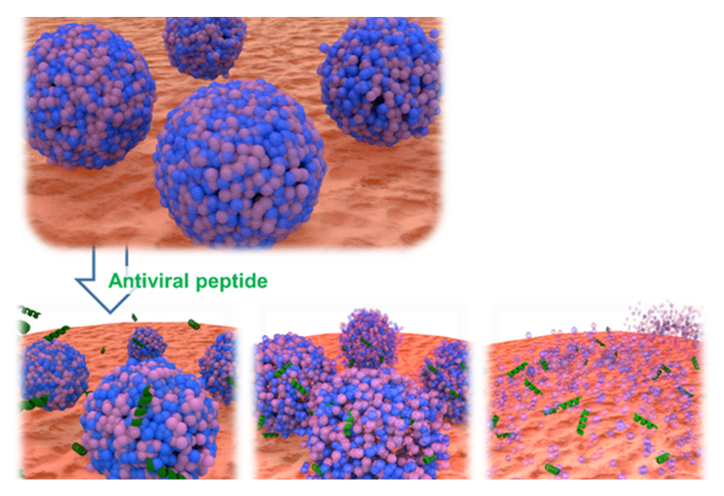
AH-D is a proprietary 27-mer amphipathic alpha-helical peptide engineered from the N-terminus of the HCV NS5A protein. The D-amino acid enantiomeric form is used to improve protease resistance, enhanced serum stability, and overall biological stability and bioavailability.
The peptide belongs to Macro HRD's functional peptide platform and is positioned as a broad-spectrum antiviral technology against membrane-enveloped viruses and extracellular vesicles.
AH-D senses high membrane curvature, especially highly curved lipid membranes below approximately 300 nm diameter that are characteristic of many viral envelopes and extracellular vesicles. The peptide inserts into these curved membranes, oligomerizes to form pores, and causes irreversible rupture of viral particles and extracellular vesicles.
AH-D recognizes highly curved lipid membranes characteristic of viral envelopes and extracellular vesicles.
The amphipathic alpha-helix inserts into the lipid bilayer of the viral membrane.
Peptide oligomerization creates membrane pores that destabilize the envelope.
The membrane loses structural integrity, resulting in irreversible rupture and loss of infectivity.
The LEAD strategy: selective rupture of viral envelopes.
AH-D peptide binds and lyses lipid membranes of enveloped virus particles based on membrane curvature. Because all enveloped viruses share a host-derived membrane, the mechanism is broad-spectrum by design — and because host cell membranes lack the high curvature of virions, it is also selective.
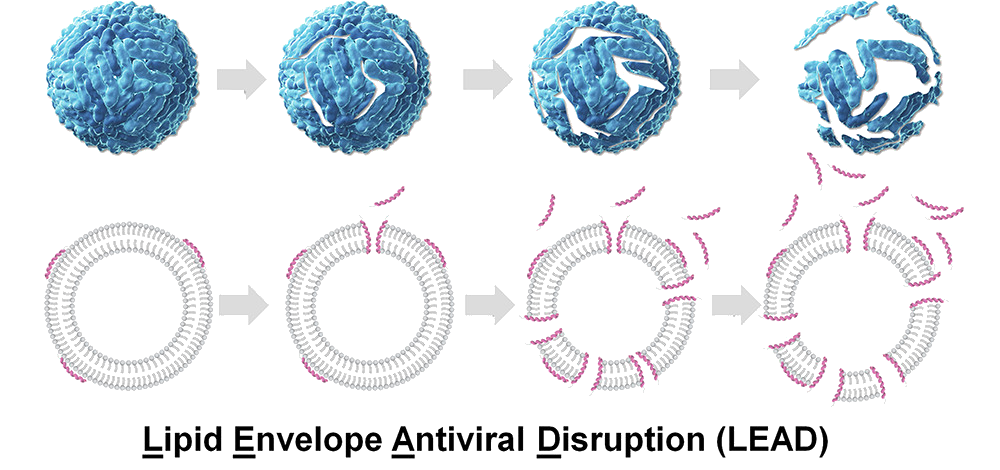
Amphipathic α-helix associates with the curved viral lipid envelope; coil-to-helix transition on membrane contact.
High-curvature viral membranes are preferentially recognized; flat host plasma membranes are spared.
Critical peptide-to-lipid ratio triggers nanoscale pore formation and membrane destabilization.
Envelope rupture inactivates virions and blocks new infection — broad-spectrum, low-resistance.
The LEAD approach connects peptide engineering, membrane biophysics, computational modeling, and virological testing to evaluate membrane-active antiviral peptides across enveloped viruses and extracellular vesicles.
Research-stage evidence supports broad-spectrum activity across 15+ enveloped-virus models and pharmacology observations related to systemic and tissue-level exposure.
Research-stage evidence supports activity across Zika, Dengue, Yellow Fever, Chikungunya, Japanese Encephalitis, West Nile, and other enveloped-virus models.
Available research-stage materials include ZIKV approximately 12 nM and DENV approximately 36 nM within a reported broad activity range of 11.9-206 nM.
Reported selectivity index ranges from 308-fold to 5,331-fold in preclinical systems, with non-toxicity to mammalian cells at antiviral concentrations.
Available research-stage materials indicate BBB crossing, BBB integrity protection, brain concentration approximately 400-600 nM after IV bolus, and circulation half-life around 7 hours in mice.
Available research-stage materials indicate therapeutic concentrations maintained in blood, brain, spleen, and kidney for 12-24 hours post-injection.
Research-stage testing indicates no cytotoxicity at therapeutic doses and non-toxic behavior to mammalian cells at antiviral concentrations.
AH-D is active as a membrane-targeting peptide on its own and does not require LNP to work. When paired with AH-D, LNP functions as an optional formulation strategy for half-life, tissue exposure, route of administration, local retention, or tolerability, rather than a requirement for AH-D's membrane-active mechanism. Any AH-D + LNP pairing is evaluated formulation by formulation because lipid composition can affect membrane-active peptide behavior.
Exploratory formulation or local-delivery applications may be evaluated separately where the mechanism is scientifically appropriate. AH-D's disclosed mechanism applies to lipid-enveloped viruses; non-enveloped viruses such as HPV require separate HPV-specific evidence.
Zika, dengue, yellow fever, Japanese encephalitis, and related enveloped viruses where lipid-envelope targeting is mechanistically relevant.
Influenza and coronaviruses as future enveloped-virus areas where membrane-targeting rationale may be explored.
Ebola and other high-consequence enveloped viruses where broad-spectrum first-line countermeasure concepts may be relevant.
HPV-adjacent or mucosal use is positioned around local delivery, mucosal retention, or epithelial targeting rather than enveloped-virus membrane-disruption language.
Advanced LNP may be evaluated as optional formulation support for exposure, retention, route of administration, or tolerability. The HIV trispecific antibody and HPV topical programs remain separate program stories with separate mechanisms.